
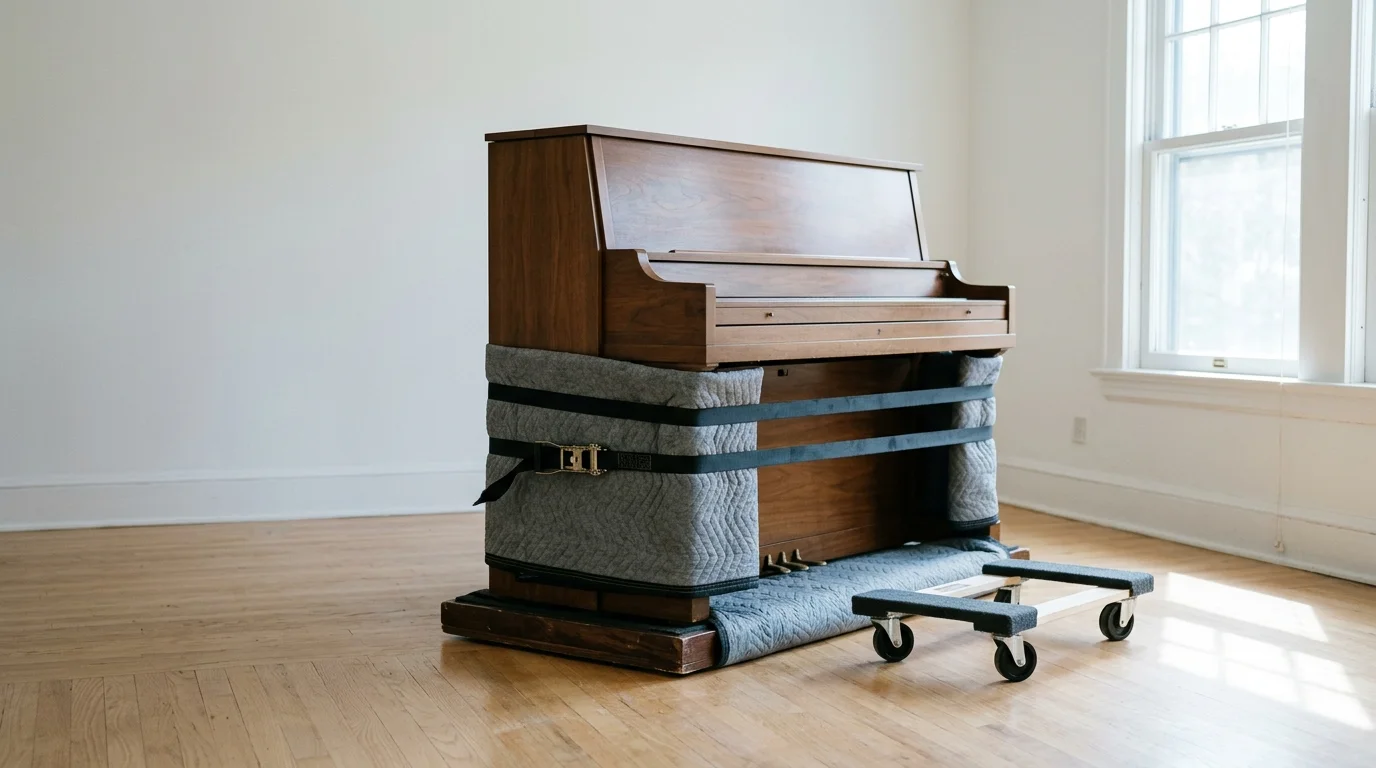
How Much Does a Piano Weigh? Upright, Baby Grand, and Grand Weights
It is the first question we get on almost every call: how much does this thing weigh? It's a fair question, and the honest answer is that piano weight varies more than most people expect. Two instruments that look nearly identical in a living room can differ by 200 pounds depending on the plate, the case material, and the era they were built in.
Here's the working range we use after 35+ years of piano moving across San Diego County, plus the part nobody tells you: weight is not the variable that decides your crew size or your quote.
Upright piano weight by type
Uprights are measured by height, and height correlates closely with weight because a taller case holds a longer plate and longer strings.
- Spinet (36 to 38 inches tall): roughly 300 to 400 lbs
- Console (39 to 43 inches): roughly 350 to 450 lbs
- Studio (44 to 47 inches): roughly 450 to 550 lbs
- Full or professional upright (48 to 60 inches): roughly 500 to 800 lbs
Older full uprights from the 1900s through the 1930s are the outliers. Those instruments were built with heavy hardwood cases and thick cast iron plates, and we regularly find them closer to 900 pounds. If your piano has an ornate carved case, candle sconces, or a manufacturer nobody recognizes, assume it's on the heavy end until we see it.
Grand piano weight by size
Grands are measured by length, from the front edge of the keybed to the far end of the tail. Steinway's own model lineup is a useful frame of reference here — their Model S baby grand is 5'1" and their Model D concert grand is 8'11", and that four-foot spread covers most of what exists in the residential market.
- Petite grand (4'5" to 4'11"): roughly 400 to 500 lbs
- Baby grand (5'0" to 5'6"): roughly 500 to 650 lbs
- Medium grand (5'7" to 6'0"): roughly 600 to 700 lbs
- Living room or parlor grand (6'1" to 6'8"): roughly 650 to 800 lbs
- Semi-concert grand (6'9" to 7'6"): roughly 800 to 950 lbs
- Concert grand (7'7" to 9'0" and up): roughly 900 to 1,200 lbs
Organs are their own category and don't map to these numbers at all. A Hammond B3 with a Leslie cabinet, for example, splits into two pieces that each behave differently in transit — we cover that in our guide to moving a Hammond B3 in Southern California.
Why weight is not the number that matters
A trained crew with piano boards, skids, and rated straps can move 900 pounds up a straight staircase without drama. What actually makes a move hard is how the weight is arranged.
An upright piano carries roughly 70% of its mass in the top half of the case — the plate, strings, and action all sit high. That makes it top-heavy and prone to tipping the instant it leaves level ground, which is why uprights get strapped to a board rather than walked on a dolly. A grand piano is the opposite problem: the weight is spread across a wide, shallow footprint with three legs holding it, and once those legs come off it has to be supported along its entire straight side.
This is also why two pianos of identical weight can price differently. Our breakdown of what movers charge by piano type walks through how access, stairs, and disassembly drive the quote far more than pounds do.
Floor loading in San Diego homes and condos
Homeowners ask about floors more than they used to, especially in downtown San Diego high-rises and second-story units. Residential floors are typically engineered for 40 pounds per square foot of live load. A 700-pound baby grand spread across a footprint of about 25 square feet works out to roughly 28 pounds per square foot — comfortably inside spec.
Concentrated load is the real consideration. A grand piano rests on three caster cups, and each one can carry over 200 pounds on a few square inches. On engineered hardwood, luxury vinyl plank, or older tile, that's enough to leave permanent dents. We bring caster cups and set the piano so the load spreads, and we recommend rugs or pads under grands sitting on soft flooring. Balconies and decks are a different story — never put a piano on one without an engineer's sign-off.
Doorway and hallway math
Weight rarely stops a move. Geometry does.
An upright strapped to a piano board is about 25 to 30 inches deep and needs about 60 inches of vertical clearance. A grand piano on its side, legs removed and on a board, is roughly 24 to 30 inches wide and up to 60 inches tall, with the length running the long way. Standard interior doors are 30 to 32 inches; exterior doors are usually 36. It fits — as long as the turn radius on the other side of that door is there.
Overhead clearance is the one that catches people out. Low soffits, arched entries, and chandeliers all come up in stair moves, and it's worth mentioning them on the phone before we arrive.
Crew size by piano
For most jobs the mapping is straightforward: two movers for a spinet, console, or studio upright on a level path; three for a full upright, any baby grand, or anything with stairs; four or more for concert grands, organs, or exterior stair runs. That's the same crew logic we use whether the job is a five-mile move across Chula Vista or a long-distance move out of state.
Not sure what you have?
Measure the height if it's an upright, or the length from keybed to tail if it's a grand, and find the brand name on the fallboard. That's enough for us to quote it. Send us those two details or call and we'll tell you the weight class, the crew, and the price in the same conversation.
Further reading
Steinway Grand Piano Models & Dimensions — Steinway & SonsNeed a piano moved in Southern California?
San Diego Piano Movers has moved pianos across San Diego, Riverside, Orange County, and beyond since 1989. Call for a free quote from a piano-only specialist crew.
More from the blog
Piano Care
Moving an Antique Piano: What Changes When the Instrument Is 100 Years Old
October 12, 2026 · 6 min read
Piano Care
Moving a Piano in the Rain: How We Protect Your Instrument in Wet Weather
October 5, 2026 · 6 min read
Moving Tips
How Long Does It Take to Move a Piano? Realistic Timings by Type and Access
September 28, 2026 · 7 min read