
Moving a Piano in the Rain: How We Protect Your Instrument in Wet Weather
Southern California gets roughly ten inches of rain a year, and most of it falls between November and March. That works out to a short list of wet days — which is exactly why rain on moving day catches people off guard. The driveway is slick, the walkway is running water, and there is a 600-pound instrument that needs to get from a living room to a truck.
We have been moving pianos and organs across San Diego, Riverside, Orange, and San Bernardino counties since 1989, and rain is a routine part of winter work. Here is how we handle it, what we protect against, and the conditions where we will call you and move the date.
Why Rain Is a Bigger Problem for a Piano Than for Furniture
A piano is a wooden instrument under enormous tension, and water affects it in ways that are not always visible the day it happens.
- Finish damage. Lacquer and polyester finishes can cloud or "blush" when moisture gets trapped under a pad or a tarp. A few drops wiped off right away are nothing. Water sitting under a wet blanket for two hours is a problem.
- Steel under tension. A piano holds more than 200 strings at roughly 18 to 20 tons of combined tension. Those strings and the tuning pins are steel. Prolonged damp invites surface rust, and rusted strings sound dull and break more easily.
- Felt and leather. Hammers, dampers, and action cloth absorb humidity fast. Swollen felt means sluggish keys and sticking notes.
- Soundboard movement. Spruce soundboards expand and contract with humidity. Most instruments are happiest somewhere in the 40 to 50 percent relative humidity range, and a sharp swing is what knocks a piano out of tune.
None of that means a piano cannot be moved in the rain. It means the instrument cannot be exposed to the rain, which is a different problem and a solvable one.
How We Wrap a Piano for Wet Weather
On a dry day, moving pads and straps are enough. On a wet day we add a waterproof layer and we change the order of operations.
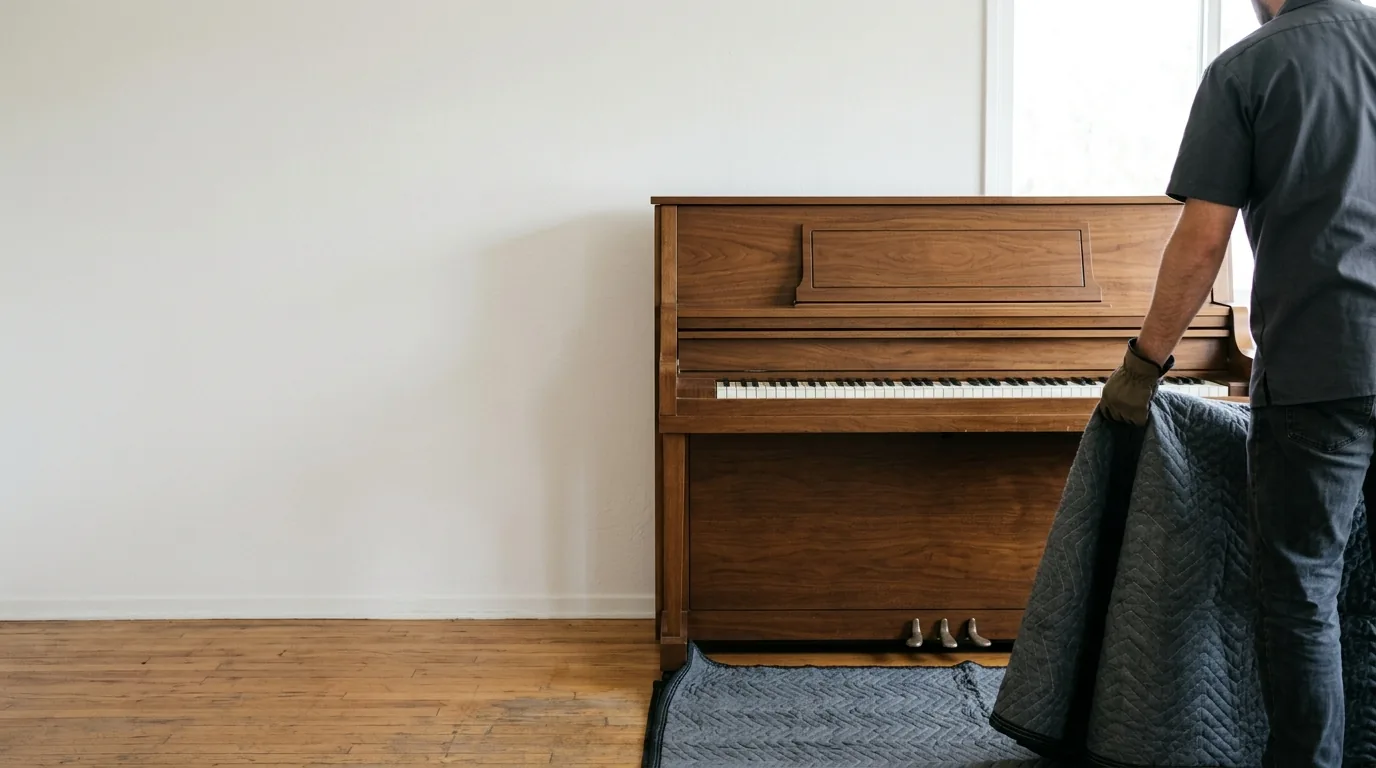
Quilted pads go on first, snug to the case and secured so nothing shifts. Over that goes a waterproof outer layer — plastic sheeting or a tarp — tied off so water runs down and away from the case rather than pooling on a lid or a music desk. The key detail is that the waterproof layer never touches the finish directly and never stays on longer than the exposed portion of the move. Once the piano is inside the truck, the wet outer layer comes off so nothing stays sealed against damp fabric.
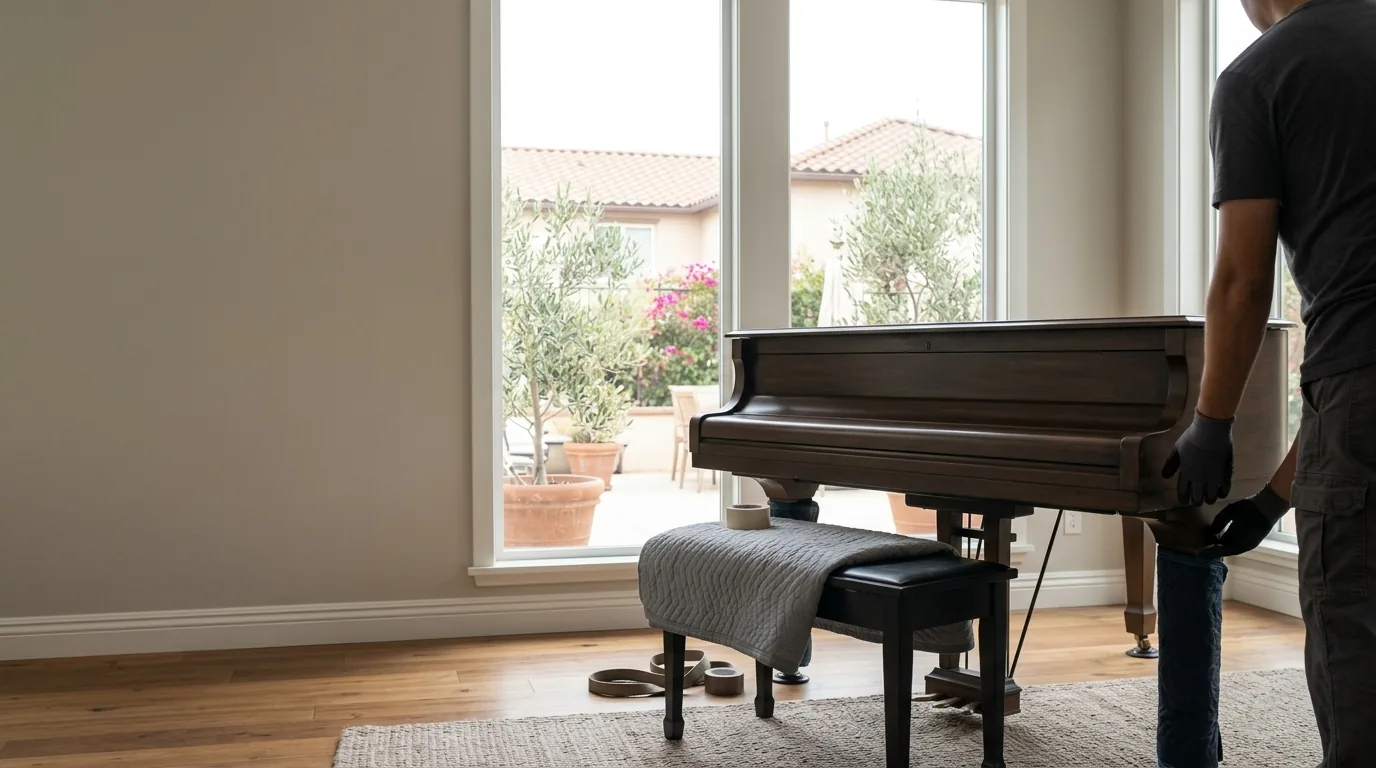
Grands get disassembled before anything leaves the house. Legs, lyre, and pedal assembly come off indoors, the instrument goes on its side onto a padded board, and every loose component is wrapped separately. Doing that in a dry garage or entryway instead of on a wet driveway is one of the simplest wet-weather advantages there is. If you want to know what happens before the crew ever lifts, our grand piano preparation checklist walks through it step by step.
We also stage the truck as close to the door as the property allows and shorten the exposed distance. Sixty feet of wet walkway and eight feet of wet walkway are very different moves.
Traction: Ramps, Boards, and Footing
Weight is the reason rain matters so much here. A spinet or console upright runs roughly 300 to 500 pounds, a full upright 600 to 800, a baby grand 500 to 650, and a concert grand can exceed 1,000. Our post on how much a piano weighs breaks that down by type. Nothing that heavy should be rolling on a slick surface without deliberate control.
What our crews do differently when the ground is wet:
- Dry the path first. Towels on tile, entry thresholds, and the ramp surface. Sweeping standing water off a sloped driveway takes two minutes and changes the whole move.
- Board over soft ground. Wet lawns and decomposed granite turn into ruts under a loaded piano board. Plywood or planking spreads the load and keeps the dolly from sinking.
- Shorter, flatter ramp angles. If the truck can park on level pavement instead of a cambered street, we move the truck.
- More hands on the straps. On a wet grade, control comes from people and straps, not from brakes and momentum.
Stairs deserve extra caution. Wet exterior steps — especially smooth concrete or glazed tile — are the single most common slip hazard on a rainy move. We cover the specifics in moving a piano up stairs, and in heavy rain we will often pause the stair portion until the worst of a cell passes rather than push through it.
Protecting Your Home: Thresholds and Floors
The piano is not the only thing that needs protection. Water tracked across hardwood, carpet, or a condo's shared corridor becomes your problem after we leave.
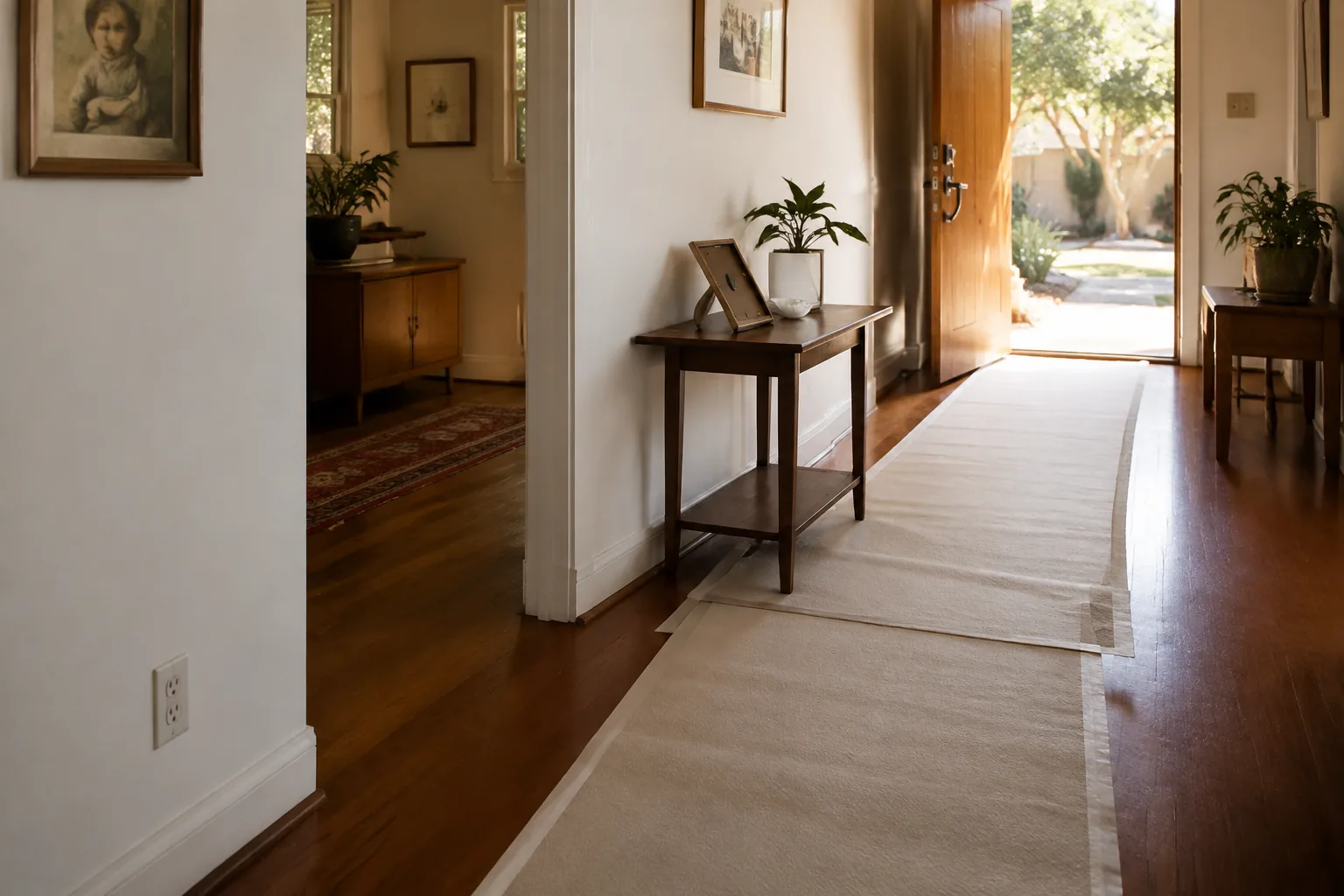
Our crews lay runners or drop protection across the interior path, pad the door threshold so the dolly does not gouge it, and keep a dedicated set of towels at the entry point so the equipment gets wiped before it crosses the door. In buildings with shared hallways and elevators, the property manager usually has rules about floor protection and may require a certificate of insurance — worth sorting out in advance, as we explain in our guide to moving a piano into a San Diego apartment or condo.
When We Reschedule
Most San Diego rain is light and intermittent, and a well-wrapped piano travels through it fine. We reschedule when conditions make the move unsafe or make damage likely regardless of technique:
- Heavy, sustained rain during an atmospheric river event, when the exposed stretch cannot be covered quickly enough.
- High wind with rain. Wind turns a tarp into a sail and makes ramp work genuinely dangerous.
- Standing water or flowing runoff on the approach, driveway, or walkway.
- Flood advisories or road closures on the route, which matters most on inland runs through Riverside, Temecula, or the pass communities.
We watch the National Weather Service forecast for the move window and call you early rather than at the door. If a date has to shift and your closing or delivery timeline cannot, our climate-controlled piano and organ storage gives the instrument a dry, stable place to sit until the weather clears.
What You Can Do Before We Arrive
A few things on your end make a wet-weather move faster and safer:
- Clear the driveway so the truck can get close to the door.
- Trim back wet shrubs or branches along the walking path.
- Have towels or a mat ready inside the door.
- Unlock gates and move cars the night before, not at 8 a.m. in the rain.
- Tell us about steep driveways, unpaved sections, or steps that get slick — it changes how we staff the job.
After a Rainy Move
Let the piano acclimate for two to four weeks before you have it tuned. Pitch changes come from the humidity and temperature shift between two rooms, not from the drive itself, and tuning too early means paying twice. We explain the timing in should you tune your piano after a move. Humidity swings run the other direction in August, which we cover in our summer piano moving guide. We move pianos and organs only — we do not tune, repair, or sell them — so your technician is a separate call.
Get a Quote for a Winter Move
Rain does not have to push your schedule. Tell us the instrument, both addresses, and what the approach looks like at each end, and we will tell you honestly whether the weather window works. You can reach us at (800) 499-5733, read more about local piano moving, or request a quote and we will follow up with a plan for your date.
Further reading
National Weather Service — NOAA National Weather ServiceNeed a piano moved in Southern California?
San Diego Piano Movers has moved pianos across San Diego, Riverside, Orange County, and beyond since 1989. Call for a free quote from a piano-only specialist crew.
More from the blog
Moving Tips
How Long Does It Take to Move a Piano? Realistic Timings by Type and Access
September 28, 2026 · 7 min read
Hiring a Mover
What Happens If Movers Damage My Piano? Coverage, Claims, and Documentation
September 21, 2026 · 7 min read

Piano Facts
Player Piano Moving: Why They're Heavier and More Fragile Than They Look
September 7, 2026 · 7 min read