
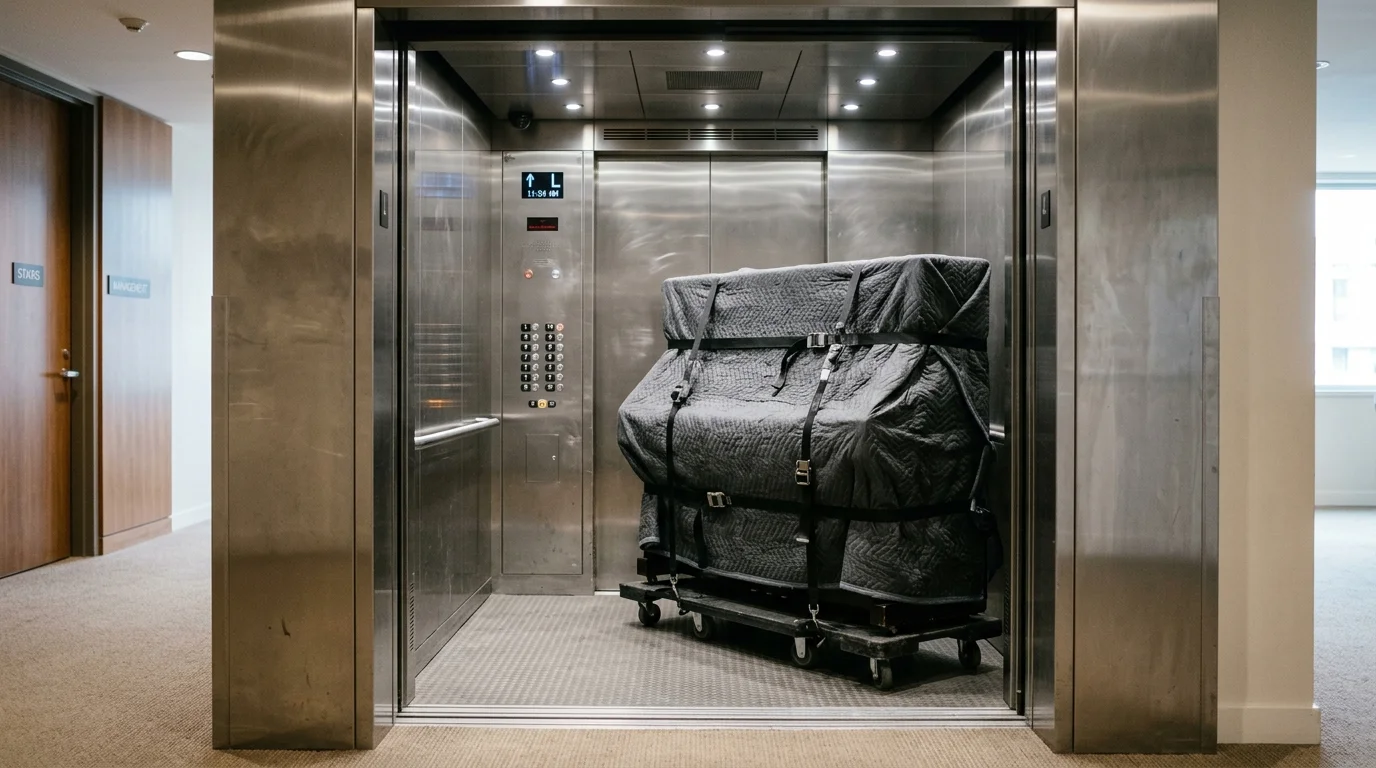
Moving a Piano Into a San Diego Apartment or Condo: Elevators, COIs, and Building Rules
We've had crews wait in a loading zone while a building manager hunted for a certificate of insurance that never made it to the right inbox. The piano was fine. The truck was fine. The paperwork was the problem — and that's the pattern for almost every apartment and condo delivery that goes sideways.
If your piano is going into a managed building anywhere from downtown San Diego to a gated community in Carlsbad, here's the sequence to run so move day is boring.
Start with one phone call to the building
Before you book movers, call the property management office or the HOA and ask five things:
- Do you require a certificate of insurance from the moving company, and with what limits and endorsements?
- What are the permitted move-in hours and days?
- Do I need to reserve the freight elevator, and how far in advance?
- Is there a loading dock or designated loading zone, and what are its clearance limits?
- Is there a move-in fee or refundable deposit?
Write the answers down. Every one of them changes what we schedule and how long the job takes.
The certificate of insurance, explained
A COI is a one-page document from the mover's insurance carrier that proves coverage exists and names your building, HOA, or management company as an additional insured for the day of the move. The building wants it so that if an elevator panel gets scratched or a lobby wall gets scuffed, there's a policy to point at rather than a homeowner.
Requirements vary a lot. Some buildings want a specific general liability limit. Some want workers' compensation listed. Some want the exact legal name of the HOA spelled a particular way and will reject a document that says "the HOA" instead. Get the building's COI requirements in writing and forward them to us — we send them straight to our carrier.
Two things are worth understanding about coverage generally. As the Insurance Information Institute explains, standard homeowners and renters policies cover your belongings at home, in transit, and in storage — but they generally will not pay for damage that happens while movers are handling the items. That gap is what the mover's cartage coverage fills, and it's separate from the building's COI. Both matter, and they cover different things.
Allow real lead time
Carriers typically issue a COI in one to three business days. Building managers then review it, and that review can take a few days more, especially if an HOA board has to sign off. Plan on about ten business days between "I have the requirements" and "the truck arrives."
If you're on an escrow deadline, tell us on the first call. We can usually get a COI request moving the same day, and we can sequence the piano delivery separately from the rest of your move so a slow HOA doesn't hold up everything else.
Elevators: the measurements that decide everything
An upright piano strapped to a piano board is roughly 60 inches tall, 25 to 30 inches deep, and as wide as the piano is long — usually 58 to 62 inches. A grand piano on its side with the legs removed is similar in height and depth, with the length of the case running the long way.
So the numbers we need from the freight elevator are: door opening width, interior depth, interior width, and interior ceiling height. Ceiling height is the one that gets missed. Many freight elevators have a removable ceiling hatch that adds a foot or more of clearance, and building engineers can often open it for a delivery — but only if somebody asks in advance.
If the piano genuinely won't fit, the fallback is the stairwell. That's a real option, not a disaster, but it changes crew size and cost. Our guide to moving a piano up stairs covers what makes a stairwell workable — the turns matter more than the step count.
Padding, protection, and the parts buildings care about
Most managed buildings require elevator pads hung before the move and floor protection through the lobby and corridors. Some provide the pads; some expect the mover to bring them. We carry our own floor runners and jamb protection either way, but confirm which side is supplying elevator pads so nobody is improvising in the lobby.
Also ask whether the building requires movers to use a specific service entrance. Downtown high-rises frequently do, and the service entrance is sometimes a longer carry from the street than the front door — which affects the quote.
Loading zones and parking
Downtown San Diego, Little Italy, and East Village are the tight ones. If the building has no dock, we may need a temporary loading zone or at minimum a reserved curb space. In smaller complexes across Oceanside and Chula Vista, the constraint is usually low parking-garage clearance — most residential garages run 6'8" to 7'0", and a box truck is not fitting under that. In that case we park at street level and carry, and you want to know that before move day rather than during it.
The destination room
Once you're inside, pick the wall before we arrive. In a condo, keep the piano off exterior walls with large windows and away from HVAC vents and the water heater closet. Grand pianos ideally sit with the straight side toward an interior wall. Weight is rarely an issue in a modern building, though it's worth knowing what your instrument actually weighs — our piano weight guide breaks it down by type. And if you have a downstairs neighbor, a rug under the instrument does more for that relationship than anything else you can buy.
When the unit isn't ready yet
Escrow gaps, renovations, and lease timing mean the piano sometimes needs somewhere to go first. We hold instruments in climate-controlled storage and re-deliver with the same crew, so no third party handles it at the warehouse door. That's usually a cleaner answer than parking a piano in a garage while the flooring gets finished — our post on why climate control matters in Southern California explains what a hot garage actually does to a soundboard.
The short checklist
- Get the building's COI requirements in writing, then send them to us
- Reserve the freight elevator and confirm the move-in window
- Measure the elevator: door width, interior depth, interior width, ceiling height
- Confirm loading dock or curb access and garage clearance
- Ask about move-in fees and who supplies elevator pads
- Allow about ten business days for paperwork
Bring us that list and we'll handle the rest. Request a free quote for your local piano move and mention the building on the first call — it's the single detail that most changes how we schedule.
Need a piano moved in Southern California?
San Diego Piano Movers has moved pianos across San Diego, Riverside, Orange County, and beyond since 1989. Call for a free quote from a piano-only specialist crew.
More from the blog
Piano Care
Moving an Antique Piano: What Changes When the Instrument Is 100 Years Old
October 12, 2026 · 6 min read
Piano Care
Moving a Piano in the Rain: How We Protect Your Instrument in Wet Weather
October 5, 2026 · 6 min read
Moving Tips
How Long Does It Take to Move a Piano? Realistic Timings by Type and Access
September 28, 2026 · 7 min read