
How Long Does It Take to Move a Piano? Realistic Timings by Type and Access
The most common question we get after "what does it cost" is "how long will you be here." It is a fair question. You may need to take time off work, hold an elevator reservation, or coordinate with a buyer, a seller, or a flooring installer.
The honest answer: most local piano moves take two to four hours door to door. But that range hides a lot. A spinet on a ground floor with a driveway can be finished in about 90 minutes. A 7-foot grand going up an exterior staircase in Mission Hills, with a truck parked two houses down, can take five hours or more. Here is how the time breaks down and what pushes it in either direction.
The four phases of a piano move
Every job, from a studio upright to a concert grand, runs through the same four phases. Knowing which one is eating your clock helps you understand the estimate.
1. Assessment and prep (15 to 45 minutes)
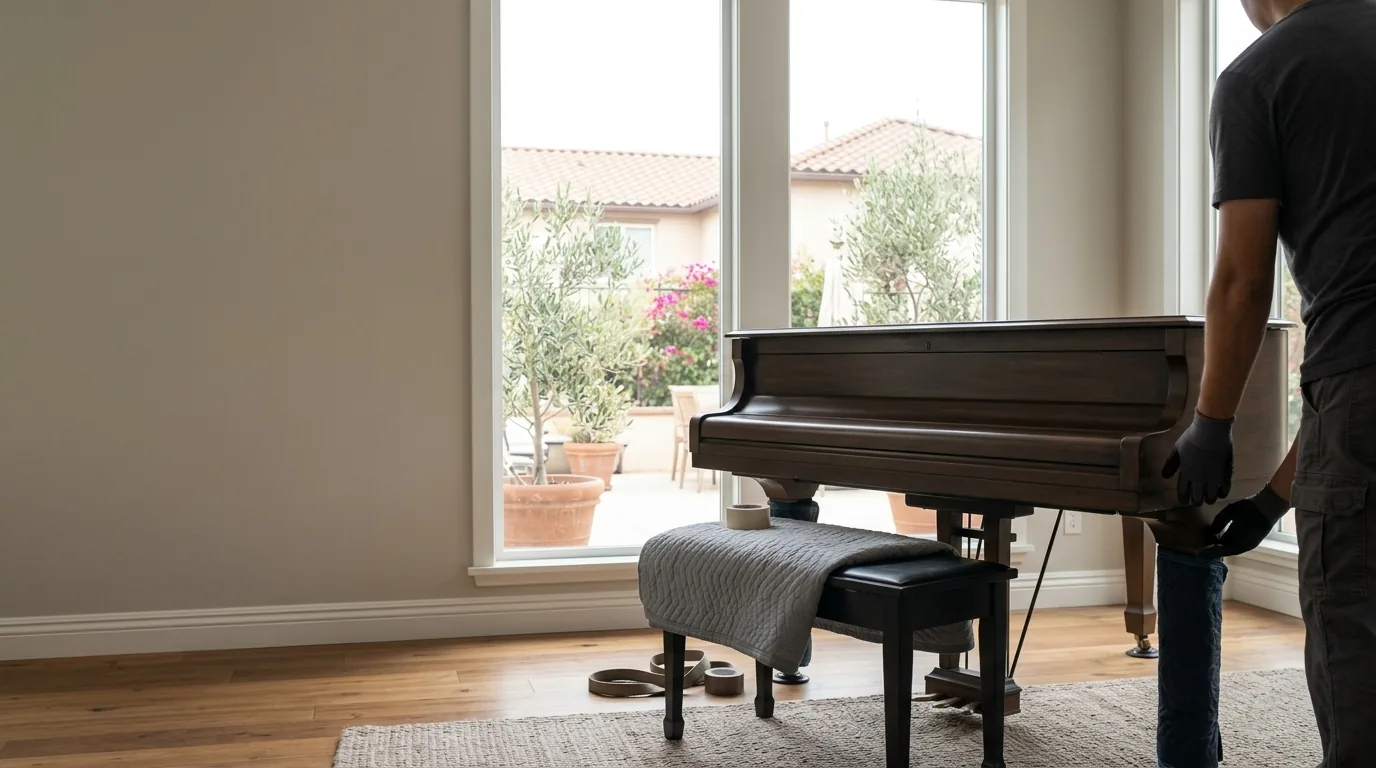
Our crew walks the route before anything moves: measuring doorways, checking stair treads, confirming where the truck can legally park, and laying floor protection. For a grand, this phase also includes removing the lyre, pedals, and legs and getting the instrument onto the piano board. That alone is typically 20 to 30 minutes of careful work.
For uprights, prep is shorter — wrapping, strapping to a skid or dolly, and clearing the path. Owners who have already moved furniture, rolled up rugs, and cleared the driveway routinely save the crew 15 minutes right here. Our grand piano preparation checklist covers what you can do the night before.
2. Load out (20 minutes to 2 hours)
This is the phase with the widest spread, and it is almost entirely about access, not the piano. Flat, level path to the truck with a wide door? Twenty to thirty minutes. Two flights of switchback stairs, a 31-inch door, and a gravel side yard? You are looking at well over an hour with a larger crew.
3. Transit (highly variable)
Driving time is what it is. Within the city of San Diego, most crosstown runs are 20 to 45 minutes. Carlsbad to Chula Vista can be 90 minutes in afternoon traffic on I-5. A run out to Palm Desert or Temecula turns a same-day local job into a half-day commitment. We build realistic drive windows into scheduling, which is why we ask for the delivery address up front rather than after booking.
4. Unload and placement (30 minutes to 2 hours)
Unload mirrors load out, plus reassembly. Reattaching grand legs, the lyre, and pedals and leveling the instrument is another 20 to 40 minutes. Then there is placement: sliding the piano into position, setting caster cups if you have them, and confirming you actually like where it sits. Homeowners who are undecided about placement add real time — we would rather you decide once, before the piano is unwrapped.
Typical total times by piano type
These assume a local move with reasonable access at both ends and no stairs.
- Spinet or console upright (300–450 lbs): 1.5 to 2.5 hours total
- Studio or full upright (450–800 lbs): 2 to 3 hours total
- Baby grand, 5' to 5'8" (500–650 lbs): 2.5 to 3.5 hours total
- Medium to large grand, 6' to 7' (650–900 lbs): 3 to 4.5 hours total
- Concert grand, 9' (900–1,300 lbs): 4 to 6 hours total
- Console or spinet organ: 2 to 3 hours total
- Hammond B3 with Leslie cabinet: 3 to 4.5 hours total
If you are not sure which category yours falls into, our breakdown of piano weights by type will get you close. Manufacturers publish exact specifications for current models — Kawai America, for example, lists dimensions and weights for each instrument in its line, which is useful if you have a newer piano and want a precise figure.
The variables that stretch two hours into five
Stairs
Stairs are the single biggest time multiplier. A straight run of 8 to 12 steps with a handrail on one side is manageable. Switchbacks, narrow treads under 10 inches, open risers, and tight landings are what turn a job long. Each flight in each direction can add 30 to 60 minutes and often requires a larger crew. We go deeper on this in our guide to moving a piano up stairs.
Doorways and turns
A standard 36-inch door is comfortable. A 30-inch door with a 90-degree turn immediately behind it is not. Uprights need roughly 26 to 30 inches of clear width on edge; grands on a board are more forgiving in width but need swing room for the corner. Door removal, when necessary, adds 10 to 20 minutes per door.
Truck parking distance
Every additional 50 feet between the truck and the door adds time, and it adds more on inclines or unpaved surfaces. In older Riverside and San Diego neighborhoods with permit parking and narrow streets, staging the truck can genuinely take 15 to 20 minutes on its own.
Elevators and building rules
Condo and apartment moves come with their own clock. Freight elevator reservations, certificates of insurance, loading dock windows, and building manager sign-offs can add an hour of waiting even when the physical move is simple. Start that paperwork a week out — our post on moving a piano into a San Diego apartment or condo walks through what buildings usually require.
Player systems and unusual instruments
Player pianos carry an extra 80 to 200 pounds of mechanism and need more careful handling; see why player pianos are heavier than they look. Church organs with separate consoles, pedalboards, and speaker cabinets are effectively multi-item moves and are scheduled accordingly.
Weather
Inland heat in summer slows crews down for good reason — both for the people carrying the instrument and for the instrument itself. Rain means extra wrapping and more careful footing. We cover the seasonal side in summer piano moving and humidity.
What about long-distance and storage moves?
Timelines change completely once you leave the region. A long-distance piano move is measured in days, not hours: pickup happens on one date, delivery falls inside a window that depends on routing and distance. On-site time at each end still follows the same phases described above.
If your new home is not ready, climate-controlled piano and organ storage splits the job into two visits — a load-out now and a delivery later — each with its own time requirement.
How to keep your move on the short end
- Clear the path at both addresses before the crew arrives
- Decide on final placement in advance, and measure the spot
- Reserve the elevator and submit any building paperwork early
- Keep driveway and curb space open, and let neighbors know
- Secure pets and keep children out of the work area
- Tell us about stairs, gates, gravel, or tight turns when you book, not on move day
Surprises on arrival are the number one reason a job runs long. Accurate information up front lets us send the right crew size and equipment the first time.
Get a realistic timeline for your piano
We have been moving pianos and organs across San Diego, Riverside, Orange, and San Bernardino counties since 1989, and we can usually tell you within a reasonable window how long your specific move will take once we know the instrument, both addresses, and the access at each end. If you are still comparing companies, our list of questions to ask a piano mover is a good place to start.
Tell us what you have and where it is going, and we will give you a straight answer on timing and cost for local piano moving. Call (800) 499-5733 or request a quote.
Further reading
Kawai America — Kawai AmericaNeed a piano moved in Southern California?
San Diego Piano Movers has moved pianos across San Diego, Riverside, Orange County, and beyond since 1989. Call for a free quote from a piano-only specialist crew.
More from the blog
Hiring a Mover
What Happens If Movers Damage My Piano? Coverage, Claims, and Documentation
September 21, 2026 · 7 min read
Piano Facts
Player Piano Moving: Why They're Heavier and More Fragile Than They Look
September 7, 2026 · 7 min read
Moving Tips
How to Get Rid of an Old Piano: Donation, Sale, and Disposal Options
September 3, 2026 · 7 min read