
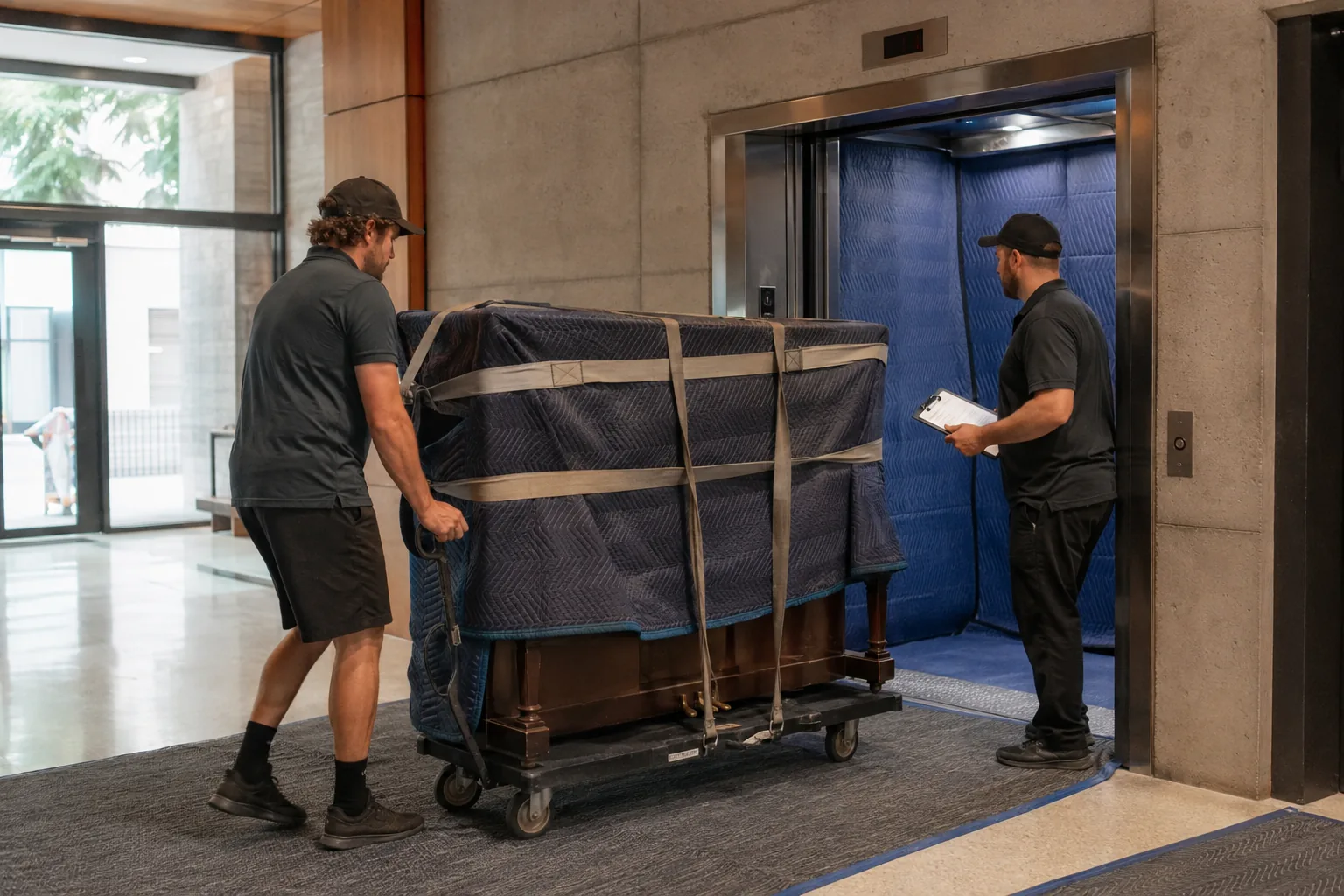
Moving a Piano Into a Storage Unit: Why a Standard Unit Is the Wrong Choice
Almost every week someone asks us to move a piano into a self-storage unit they already rented. Sometimes it's a remodel, sometimes a sale that fell through, sometimes a parent's house being cleared out. The unit is usually a 5x10 or 10x10 at a facility a few miles away, and the price looked reasonable.
We'll do the move if that's what you want. But before you sign the rental agreement, it's worth knowing what a standard storage unit does to a piano in Southern California, because the damage is rarely visible on day one and it is almost never cheap to undo.
A piano is not furniture, and storage units are built for furniture
A piano is roughly 10,000 moving parts, most of them wood, felt, leather, and steel, held together under tension. A typical upright carries 15 to 20 tons of combined string tension. The soundboard is a thin spruce panel that is deliberately built with a slight crown, and that crown depends on the wood holding a stable moisture content.
Weight matters too. Uprights generally run 300 to 800 pounds depending on size and age, baby grands land around 500 to 650, and full grands climb past 1,000. If you want the specifics for your instrument, we break them down in our guide to how much a piano weighs. That mass is why a storage unit's physical layout matters as much as its climate.
What the inland heat actually does
Most self-storage in our service area is either a metal drive-up building or an interior unit in an uninsulated shell. In Riverside and San Bernardino counties, and especially out in the Coachella Valley, summer afternoons regularly push past 110 degrees. The interior of a closed metal unit can run well above the outside air temperature for hours at a stretch.
Heat on its own softens the hide glue used in older actions and case joints. Combine it with the extremely low humidity typical of inland summers and you get the second problem: the wood gives up moisture, the soundboard crown flattens, ribs can separate, and tuning pins lose their grip in the pinblock. The piano goes flat, sometimes by a half step or more, and no amount of tuning fixes a cracked soundboard. We cover the seasonal side of this in our post on summer piano moving and San Diego heat and humidity.
Coastal storage has the opposite failure mode. Salt air and sustained high humidity near the water put rust on strings, tuning pins, and action hardware, and swell felt until keys sluggishly stick. Institutions that store wooden and mixed-material objects long term control both temperature and relative humidity for exactly this reason — the Library of Congress preservation program is a good plain-English starting point on why stable environments protect organic materials.
Pianos are happiest somewhere around 68 to 72 degrees with relative humidity held near 42 to 50 percent, and more importantly, held steady. It's the swing that cracks things, not any single reading.
"It says climate-controlled on the sign"
Read the fine print. At many general-purpose facilities, climate control means the temperature is kept inside a broad range — often something like 55 to 85 degrees — and humidity is not actively managed at all. Some systems only run during office hours. A unit that never exceeds 85 degrees is still a unit that cycles 30 degrees and 40 percentage points of humidity across a year.
That is fine for a couch. It is not fine for a soundboard. We go deeper into the distinction in our article on climate-controlled piano storage in Southern California.
The access problems nobody mentions on the phone
Even if the climate were perfect, the building usually isn't. Things our crews run into constantly at self-storage facilities:
- Door width. Roll-up doors on smaller units are frequently 7 to 8 feet tall but the opening can be narrower than the unit itself. A grand on its side on a piano board needs real clearance, and the board adds width.
- The lip at the threshold. Drive-up units often have a 1 to 3 inch concrete or metal lip. Rolling 700 pounds over it requires ramping, not muscle.
- Interior corridors. Narrow aisles with 90-degree turns leave no room to pivot a grand. Some facilities also have weight limits on upper floors and freight elevators that are smaller than they look.
- Gate hours and carts. Facilities sometimes restrict large deliveries to certain windows, which matters when you're coordinating a same-day local piano move.
Then there's what happens inside the unit. A grand should sit on its side on a padded piano board with the legs and lyre removed and crated, not propped against a wall. An upright should stay upright on dunnage, off bare concrete, which wicks moisture. And nothing — not a box, not a mattress, not a bicycle — should be stacked against the case or lid.
What we recommend instead
We've been moving pianos and organs since 1989, and the storage side of our business exists because the self-storage option kept failing our customers. Our climate-controlled piano and organ storage is set up for instruments specifically: stable conditions, pianos stored properly on boards or dunnage, nothing stacked on them, and the same crew handling the pickup, the storage, and the redelivery so the instrument is only ever touched by people who move pianos for a living. The same applies to consoles, spinets, and electronic and pipe-adjacent instruments we handle through organ moving.
One practical bonus: when the piano comes out of proper storage, it has not been through a year of wood movement, so the post-move settling is far less dramatic. You'll still want a tuning after delivery, as we explain in should you tune your piano after a move, but you're tuning a stable instrument rather than rescuing one.
What drives the cost
We won't quote a number sight unseen, because the variables genuinely change the price. The ones that matter most:
- Type and size — upright, baby grand, grand, console organ
- Access at the pickup address: stairs, tight turns, long carries, elevator or no elevator
- Whether the piano needs to be partially disassembled and crated for the board
- Distance from our route — a pickup in San Diego prices differently than one in Palm Springs or Riverside
- How long the instrument will be stored
If you're weighing storage against simply letting the piano go, our piece on donation, sale, and disposal options lays out the honest alternatives. And if you're comparing companies, run through our 10 questions to ask a piano mover before you book first.
Get a quote before you rent the unit
The cheapest version of this problem is the one you solve before the piano is already sitting in a 10x10 in Hemet. Tell us the instrument, the address, the access, and roughly how long you need it held, and we'll tell you what's involved.
We cover San Diego, Riverside, Orange, and San Bernardino counties — the full list is on our areas we service page. Call (800) 499-5733 or send the details through our contact page, and if the move involves a building with its own rules, our notes on apartment and condo piano moves will tell you what paperwork to line up.
Further reading
Library of Congress — Preservation — Library of CongressNeed a piano moved in Southern California?
San Diego Piano Movers has moved pianos across San Diego, Riverside, Orange County, and beyond since 1989. Call for a free quote from a piano-only specialist crew.
More from the blog
Moving Tips
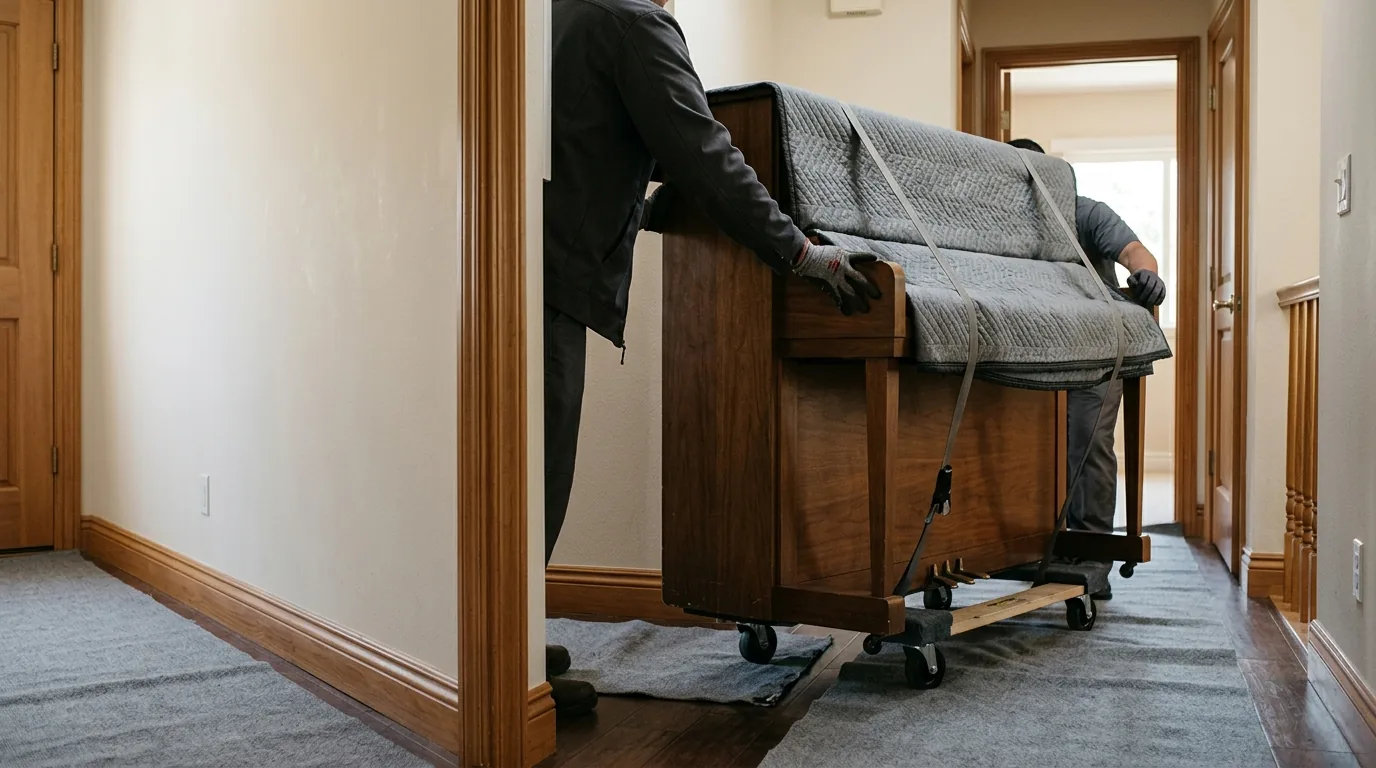
Protecting Hardwood Floors During a Piano Move: Caster Cups, Runners, and Real Causes of Damage
October 19, 2026 · 6 min read
Piano Care
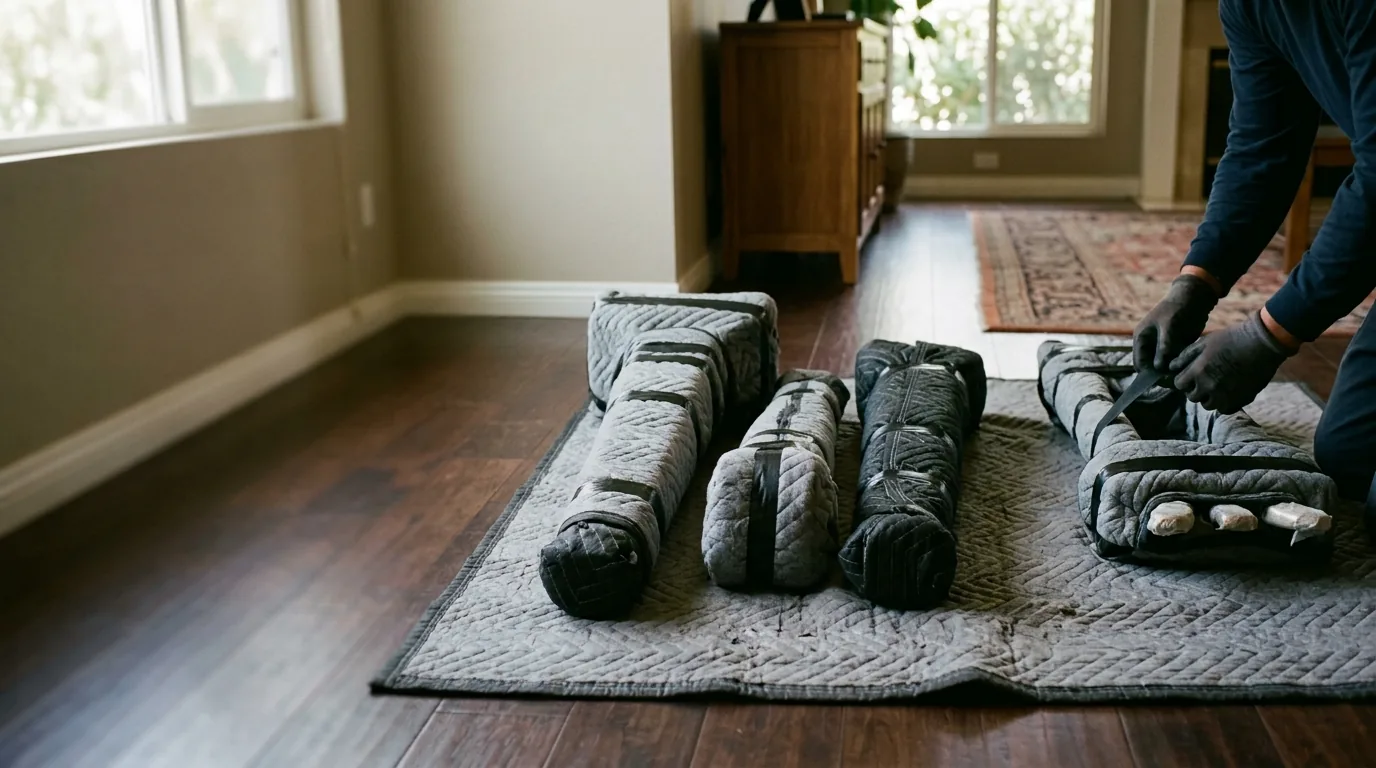
Moving an Antique Piano: What Changes When the Instrument Is 100 Years Old
October 12, 2026 · 6 min read
Piano Care
Moving a Piano in the Rain: How We Protect Your Instrument in Wet Weather
October 5, 2026 · 6 min read