
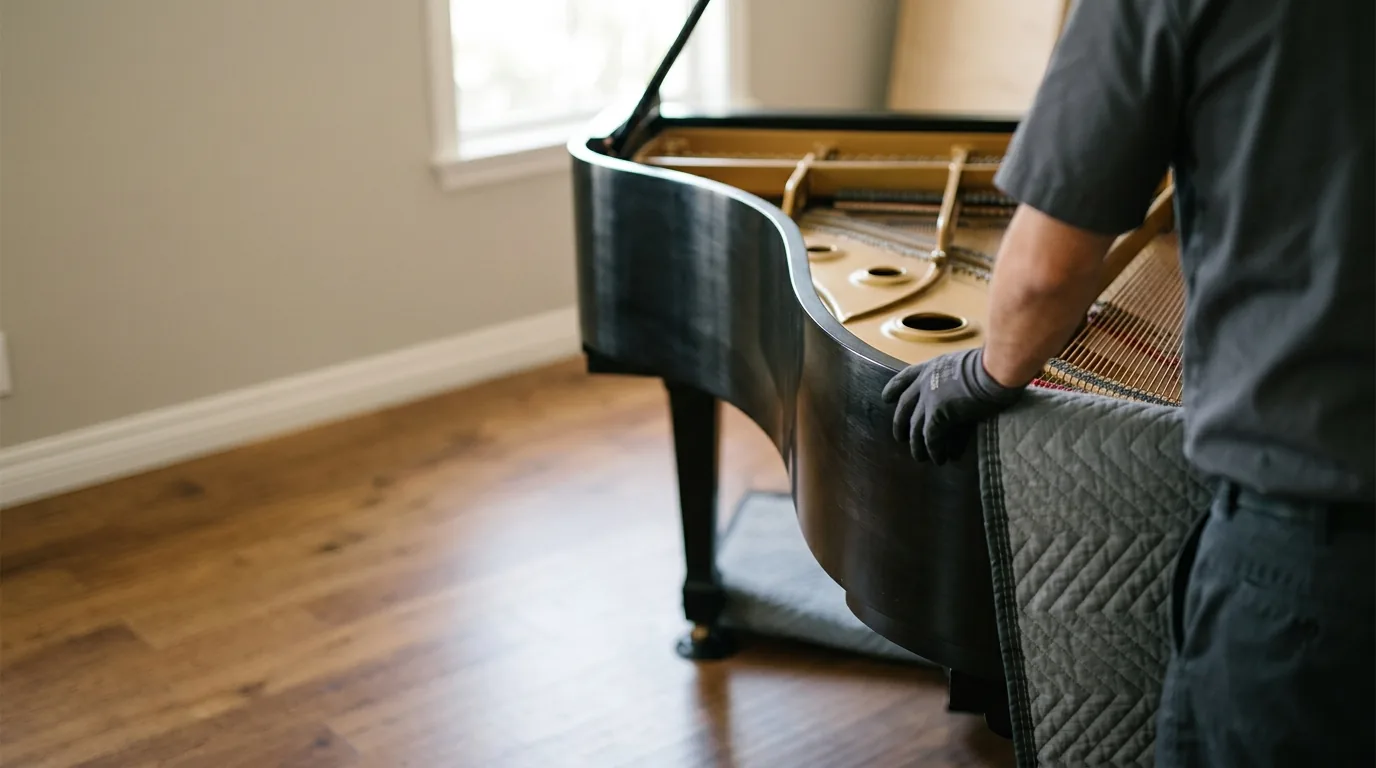
Selling a Piano: What to Do Before the Buyer Arrives
Most private piano sales fall apart for one of two reasons: the instrument looked worse in person than it did in the listing photos, or nobody worked out how it was going to get out of the house. Both are fixable before the buyer rings the doorbell.
We move pianos and organs. We don't buy, sell, tune, or repair them. But since 1989 we've shown up at both ends of private-party sales across San Diego, Riverside, Orange, and San Bernardino counties, and we've seen which deals go smoothly. Almost all of it comes down to what the seller did in the week beforehand.
Know exactly what you're selling
Before anyone comes to look, write down three things: the brand name on the fallboard, the serial number, and the measurements.
The serial number is usually stamped on the plate near the tuning pins, printed on the soundboard, or stenciled inside the lid on a grand. Buyers ask for it because it dates the instrument. Have it ready rather than digging for it while someone stands in your living room.
Measurements matter for the move. For a grand, the length from the very front of the keyboard to the farthest point of the tail is the number everyone wants. For an upright, note the height, the width, and the depth. A buyer who knows the piano is a 5-foot-7 baby grand can get a realistic quote; a buyer who only knows "it's a grand piano" cannot.
Weight is the other variable that drives the move. Spinets and consoles usually land between 300 and 450 pounds, studio and full uprights between 450 and 800, and grands from roughly 500 pounds for a small baby grand up to 1,200 or more for a 9-foot concert instrument. Our breakdown of what pianos actually weigh by type is a useful reference to send a buyer who thinks three friends and a pickup truck will handle it.
Clean it without damaging the finish
A piano that looks cared for sells faster. A piano that looks neglected invites lowball offers, even when the action and strings are fine.
- Dust the case with a soft, dry or barely damp microfiber cloth. Skip household sprays, silicone polishes, and anything with ammonia.
- Wipe the keys with a cloth lightly dampened in water, working from the back of the key toward the front, then dry them.
- Vacuum under and behind the instrument. Buyers lean down and look.
- Clear the top. Photo frames, metronomes, and sheet music piles make a piano look like furniture instead of an instrument.
- Open the lid or the top panel and let them see inside. Hiding the interior reads as hiding a problem.
Don't attempt internal cleaning, string polishing, or key regluing yourself. If something is loose or sticking, say so in the listing. Honest disclosure costs less than a buyer discovering it after the deposit.
Decide about tuning before you list
A piano that has sat untuned for years will sound sour to anyone who plays it, and that's the first impression. Some sellers have the instrument tuned to show it at its best; others price accordingly and let the buyer handle it after delivery.
There is a practical wrinkle: a piano tuned in your home will drift once it is moved to a new room with different humidity and settles there. That's why we tell both parties the tuning conversation is really a post-move conversation. If you do tune before selling, treat it as a presentation expense, not a gift to the buyer's technician schedule.
Clear and measure the access path
This is the step sellers skip, and it is the one that causes delays on moving day.
Walk the route the piano will take from where it stands to the curb. Then measure it. Our crews need to know about:
- Doorway widths. Interior doors are often 30 to 32 inches. Uprights travel upright on a dolly and usually clear those. Grands come off their legs and ride on a skid board, which changes the geometry entirely.
- Hallway turns. A 36-inch hall with a 90-degree turn is tighter than it looks with a 6-foot instrument.
- Stairs. Count them, note whether there is a landing or a turn, and check the handrails. Stairs change crew size and timing more than any other factor.
- Thresholds, planters, and gates. Narrow side gates and raised entry thresholds are common on older San Diego properties.
- Truck parking. Is there room at the curb for a box truck, or is it a permit-parking street with a steep driveway?
Then physically clear it. Move rugs, cords, shoe racks, and the console table in the entry. Trim the overgrown shrub next to the walkway. Pull cars out of the driveway. Every obstacle still in place on moving day is time somebody is paying for.
If you live in a building with an elevator and a loading dock, start the paperwork early. Many HOAs and condo associations require a certificate of insurance and a reserved freight elevator window, which is covered in our guide to piano moves in San Diego apartments and condos.
Who arranges and pays for the move
In private-party piano sales, the common convention is that the buyer pays for the move, because the buyer controls the destination and the destination is what drives most of the cost. But a convention is not a contract. Put it in writing before money changes hands.
Three arrangements we see regularly:
- Buyer books and pays. Cleanest. The buyer hires the mover, picks the date, and coordinates access at both ends. The seller's job is to be home and have the path clear.
- Seller books, buyer reimburses. Works when the seller wants control of the removal date, for example before a closing or a lease end.
- Split or seller-paid. Sometimes used as a negotiating lever on price. Fine, as long as it's spelled out.
Whoever books it, the quote depends on the same variables at both addresses: instrument type and size, stairs, distance, turns, parking, and whether a crane or special equipment is needed. That's why pricing differs so much between an upright and a grand, and why a mover will ask a lot of questions before giving a number.
One more thing worth agreeing on: who carries the risk between payment and delivery. Our notes on coverage, claims, and documentation explain what to photograph and when.
Day-of logistics
Confirm payment clears before the instrument leaves. A simple written bill of sale with both names, the date, the brand, the serial number, the price, and the words "sold as-is" protects both parties.
Take dated photos of all four sides, the keys, and the interior right before the crew arrives. If the buyer is not present at pickup, those photos are the record of condition at the moment of handoff. Buyers doing their own homework can compare them against the checks in our guide to inspecting a used piano before paying for delivery.
Keep the bench, the original key, any music-desk hardware, and the owner's manual together. Sellers routinely find them in a closet two weeks later.
If the sale slips and you need the piano out of the house on a fixed date anyway, climate-controlled storage buys you time without parking the instrument in a hot garage. And if the piano turns out to have no market value at all, which happens more often than sellers expect, our piece on donation, sale, and disposal options lays out the realistic choices. We do not haul junk, but we can tell you where a piano stands logistically. For broader context on the acoustic piano market, NAMM, the music products industry trade association, is a reasonable starting point.
Get a quote before you set a pickup date
Whether you're the buyer or the seller, get the move quoted before you agree on a date. A quote forces both addresses to be described accurately, and an accurate description is what keeps a crew from arriving to find a staircase nobody mentioned.
We handle local piano moving throughout San Diego and the surrounding counties listed on our service area page. Tell us the instrument type, the pickup address, the delivery address, and what the stairs and parking look like at each end, and reach out for a quote or call (800) 499-5733.
Further reading
NAMM, the music products industry trade association — NAMMNeed a piano moved in Southern California?
San Diego Piano Movers has moved pianos across San Diego, Riverside, Orange County, and beyond since 1989. Call for a free quote from a piano-only specialist crew.
More from the blog
Long-Distance Moving
Military PCS Piano Move in San Diego: Orders, Storage, and Long-Distance Transport
November 2, 2026 · 6 min read
Storage
Moving a Piano Into a Storage Unit: Why a Standard Unit Is the Wrong Choice
October 26, 2026 · 6 min read
Moving Tips
Protecting Hardwood Floors During a Piano Move: Caster Cups, Runners, and Real Causes of Damage
October 19, 2026 · 6 min read