
Buying a Used Piano in San Diego: What to Check Before You Pay for Delivery
A good share of our local moves are deliveries for private-party purchases — a piano bought off Facebook Marketplace in Temecula going to a home in San Diego, or an estate sale instrument in Escondido heading to a first-time buyer's living room. We're often the first professionals to touch the piano after the sale, which means we're also the ones who occasionally have to tell someone their free piano has a cracked plate.
Here's what to check before the money moves, and what to budget beyond the purchase price.
The free piano math
Free and nearly-free pianos are abundant in Southern California. They're also where most of the disappointment lives, because the purchase price is the smallest number in the transaction. A realistic total for a free upright includes:
- Professional delivery — driven mostly by stairs and access at both ends
- Tuning once it settles — one appointment, sometimes two
- A pitch raise if it hasn't been tuned in five-plus years, which is additional work, not a normal tuning
- Regulation or repair if keys stick or the action is worn
None of that is a reason to skip a free piano. It's a reason to know the number before you say yes, because a free piano that needs four figures of work is a worse deal than a modestly priced one that needs nothing.
The walk-through: what to look at
Bring a flashlight and your phone. Piano Buyer's used-piano inspection guide is the best free reference on this and worth reading in full before you go. The short version:
Serial number and age
Find the serial number — usually on the plate near the tuning pins, inside the rim on a grand, or stamped on the back of an upright. Photograph it along with the brand name. Age alone doesn't disqualify a piano, but a 1920s instrument that has never been rebuilt is a very different purchase from a 1990s one.
The plate and structure
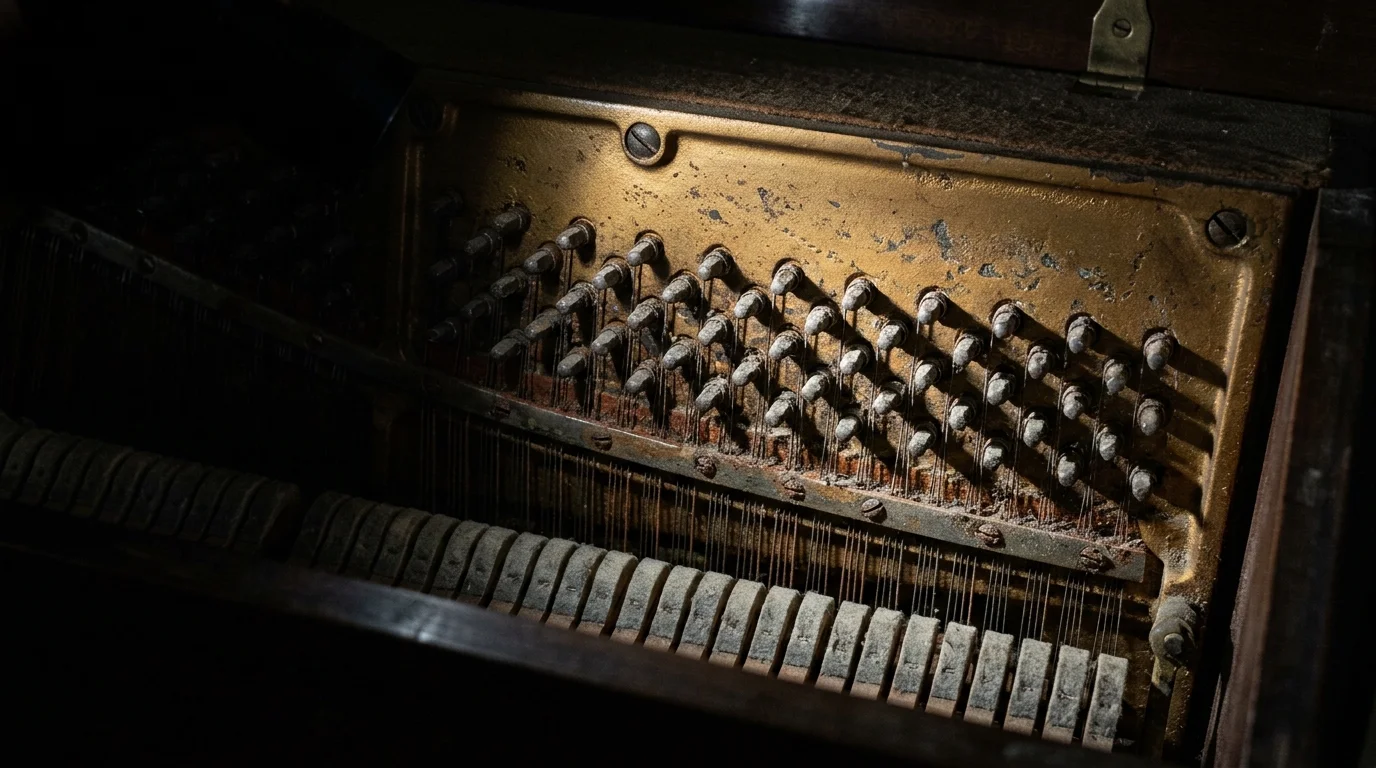
Shine the light on the cast iron plate and look for cracks. A cracked plate generally makes a piano uneconomical to repair — that's the one finding that turns a purchase into a pass. Check that case joints haven't separated and that the back posts on an upright are sound.
Strings, tuning pins, and pinblock
Light surface oxidation on strings is normal and mostly cosmetic. Heavy rust, especially through the bass strings, tells you the piano lived somewhere humid and unheated. Loose tuning pins — meaning the piano won't hold a tune — usually point to pinblock trouble, which is expensive.
Soundboard
Soundboard cracks look alarming and often aren't disqualifying, as long as the tone is acceptable and the ribs haven't separated from the board. This is exactly where a technician's opinion is worth more than yours or ours.
Action, keys, and pedals
Play every single key from bottom to top. Listen for dead notes, buzzes, and uneven volume between neighbors. Press each key and feel for sticking or sluggish return. Check keytops for chips and missing pieces. Then work all the pedals — the damper pedal should lift cleanly and release without lag.
Case and finish
Water marks, swollen wood, and separated veneer mean the piano was stored badly. Look at the bottom of the legs and at the caster wheels. On a grand, check the lyre assembly and the leg-to-case joints specifically, because those are the components that carry load during a move.
The red flags that make a piano not worth moving
We'll move anything a customer asks us to move. But if you want our honest read, four findings mean the delivery cost is probably better spent on a different instrument: a cracked plate, badly separated case joints, loose legs or a compromised lyre on a grand, and heavy rust through the bass section. Any one of those, and it's worth getting a technician's eyes on it before you pay for transport.
Pay for an inspection on anything meaningful
If the piano costs more than a service call — which is nearly all of them — hire an independent registered piano technician to inspect it before you commit. Independent matters: not the seller's technician, and not someone who would rather sell you a different piano. A one-hour inspection catches loose pins, hidden structural issues, action wear, and prior repairs, and gives you a real number for what the instrument needs. It's the highest-return hour in the whole process.
Measure the access at both ends — before you buy
This is the mistake we see most, and it's entirely preventable. Before you agree to the purchase, measure:
- The narrowest doorway and hallway on the path out of the seller's home
- Every step and turn, at both ends
- The narrowest doorway and hallway at your destination
- Overhead clearance on any stairwell
- For a grand, the length of the case — so you know it fits the destination room, not just the door
Then send us those numbers and the piano type, and we'll price the delivery before you commit. It takes one phone call, and it's the difference between a good deal and an instrument you can't get through your own front door. Our guides to piano weights and dimensions and stair moves cover the geometry in more detail.
After delivery: don't tune it yet
Give the piano at least two weeks in its new room before you book a tuner — three or four weeks if it moved between the coast and inland San Diego County, where the humidity difference is real. Tuning too early wastes the appointment because the wood is still settling. We cover the timing in should you tune your piano after a move.
Place it thoughtfully while you're at it: interior wall, away from HVAC vents, out of direct afternoon sun through a west-facing window.
If your room isn't ready
Sellers usually want the piano gone on a schedule that has nothing to do with your renovation timeline. We can pick it up, hold it in climate-controlled storage, and deliver it when your room is finished — a much better answer than a garage in August.
Buying from out of the area?
Good instruments turn up in Los Angeles, Palm Springs, and Phoenix, and a private-party purchase two states away is still workable. We run long-distance piano moves on dedicated trucks, so the piano isn't transferred between warehouses or mixed in with household freight. See what to expect on a cross-country piano move for how that scheduling works.
Before you hand over the cash
Photograph the serial number, play every key, look at the plate, measure the doorways, and get a delivery quote. Five steps, maybe an hour of your time.
Send us the details or call and we'll price the delivery before you buy — including from Murrieta, Riverside, and anywhere else in our service area.
Further reading
Inspecting a Used Piano Before Buying — Piano BuyerNeed a piano moved in Southern California?
San Diego Piano Movers has moved pianos across San Diego, Riverside, Orange County, and beyond since 1989. Call for a free quote from a piano-only specialist crew.
More from the blog
Piano Care
Moving an Antique Piano: What Changes When the Instrument Is 100 Years Old
October 12, 2026 · 6 min read
Piano Care
Moving a Piano in the Rain: How We Protect Your Instrument in Wet Weather
October 5, 2026 · 6 min read
Moving Tips
How Long Does It Take to Move a Piano? Realistic Timings by Type and Access
September 28, 2026 · 7 min read